When choosing an industrial sewing machine for shoes, leather goods or bags, stitch type is only part of the decision. The bed geometry determines how the workpiece can move around the needle, which directly affects access to flat panels, tubular parts, curved shoe uppers and already assembled three-dimensional components.
A flat bed sewing machine provides a broad horizontal working surface, a cylinder bed sewing machine uses a narrow horizontal arm that the material can wrap around, while a post bed sewing machine raises the sewing point on a vertical post so shaped footwear components can be rotated around the needle area. None is universally better—the correct choice depends on where the seam is located on the product.
For general technical reference, India's Bharat Skills leather training material compares flat-bed, cylinder-bed and post-bed machine structures. Industrial sewing manufacturer JUKI also positions post-bed designs specifically for applications such as sports shoes, leather shoes and casual footwear.
Quick Answer: Which Sewing Machine Bed Should You Choose?
| Machine Type | Best Geometry | Typical Shoe / Leather Tasks | Main Limitation |
| Flat Bed | Flat or mostly open components | Panels, straight seams, open upper components and specialized multi-needle sewing | Large table can restrict access once the product becomes three-dimensional |
| Cylinder Bed | Tubular or wrap-around parts | Binding, bags, shoe components, thick leather and items that can slide around a horizontal arm | Less suitable when the sewing point requires access around a narrow, closed three-dimensional cavity |
| Post Bed | Curved and three-dimensional components | Shoe uppers, curved seams, decorative stitching and formed leather products | Narrow working surface is less convenient for some large flat-panel operations |
A Simple Selection Rule If the material naturally lies flat during sewing, start by considering a flat bed. If the component needs to wrap around a horizontal arm, consider a cylinder bed. If a shaped shoe upper or leather product must rotate around a raised sewing point, a post bed is often the more practical geometry.
What Is a Post Bed Sewing Machine?
A post bed machine places the hook, feed area and sewing point on top of a narrow vertical column. The space around the post allows the operator to rotate and guide a three-dimensional workpiece without forcing the entire product to remain flat on a large table.
This geometry is particularly useful in footwear because an assembled or partially assembled shoe upper develops curves around the toe, side panels and heel area. The raised post gives the operator more freedom to follow these contours while maintaining visibility around the needle.
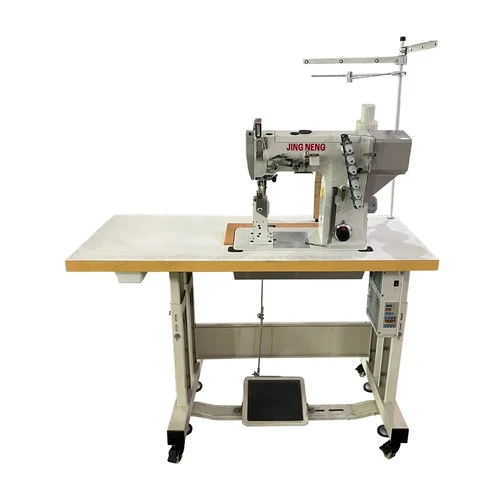
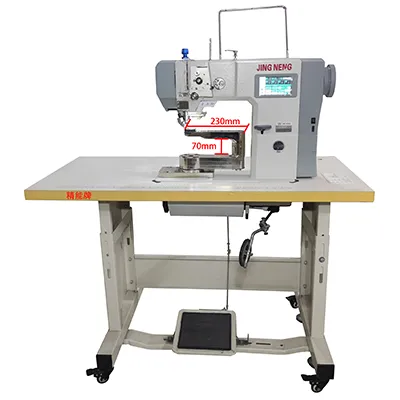
JINGNENG JN-7200 post bed sewing machine for footwear and leather sewing.
Where Post Bed Machines Are Especially Useful
Curved shoe-upper seam lines
Decorative stitching around three-dimensional uppers
Sneaker and leather-shoe panels after partial assembly
Bag corners and shaped leather goods
Areas where a broad flat table would interfere with workpiece rotation
JINGNENG offers a dedicated range of post bed shoe sewing machines including single-needle, double-needle, small-mouth and computerized models.
If you want a deeper explanation focused only on this machine structure, see Mastering Complex Sewing with Post Bed Sewing Machines.
What Is a Cylinder Bed Sewing Machine?
A cylinder bed sewing machine replaces the broad flat working surface with a narrow horizontal cylindrical arm. Tubular or curved components can slide over and rotate around this arm, making it easier to sew areas that would be awkward to position on a flat bed.
Cylinder-bed machines are widely useful for bags, leather goods, binding operations and selected footwear components. Their exact capability depends heavily on the feed mechanism, arm diameter, presser-foot lift, stitch type and machine configuration.
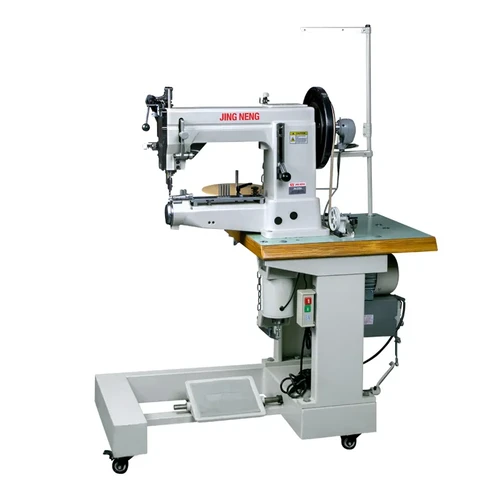
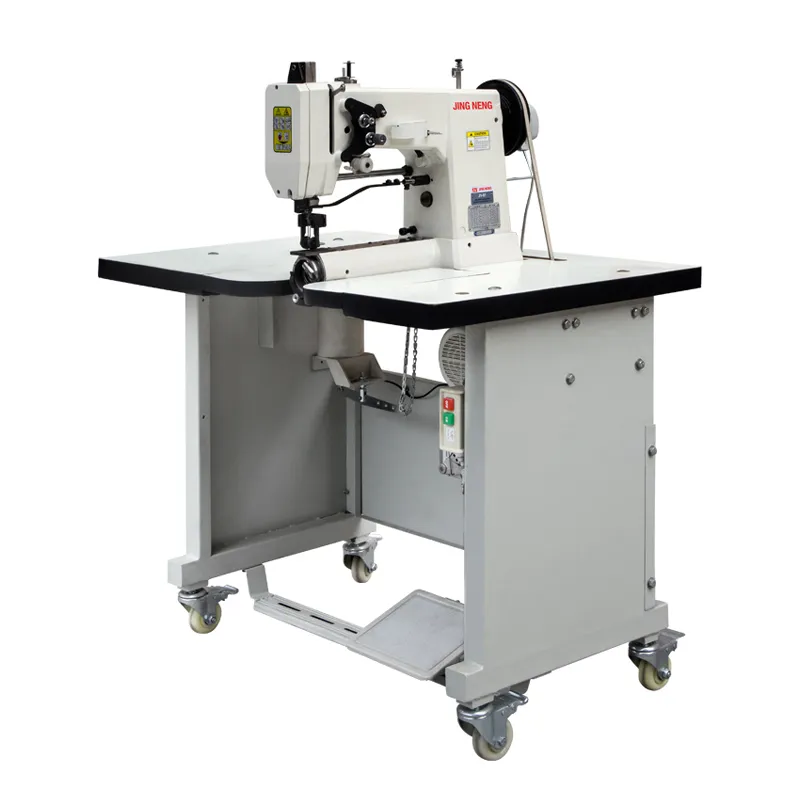
JINGNENG JN-205V cylinder bed binding sewing machine for thick leather, shoes and leather goods.
Example: JN-205V for Thick Materials and Binding
The JN-205V Cylinder Bed Binding Sewing Machine is designed for thick-material sewing and binding. Its specifications include a presser-foot lift of up to 20 mm and a 0–11 mm stitch-length range, illustrating how cylinder-bed geometry can be combined with a configuration intended for heavier leather goods.
What Is a Flat Bed Sewing Machine?
A flat bed sewing machine uses the familiar broad horizontal sewing surface found on many industrial machines. When components remain flat or open, this surface provides stable support and makes material positioning relatively straightforward.
Flat-bed construction is useful for straight seams, open panels and processes where the workpiece does not need to wrap around an arm or rotate around a vertical post. Flat-bed machines are also available in highly specialized configurations, so the bed type alone does not determine the stitch type or number of needles.
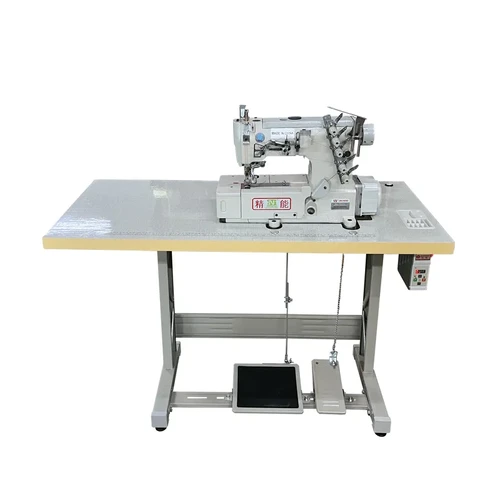
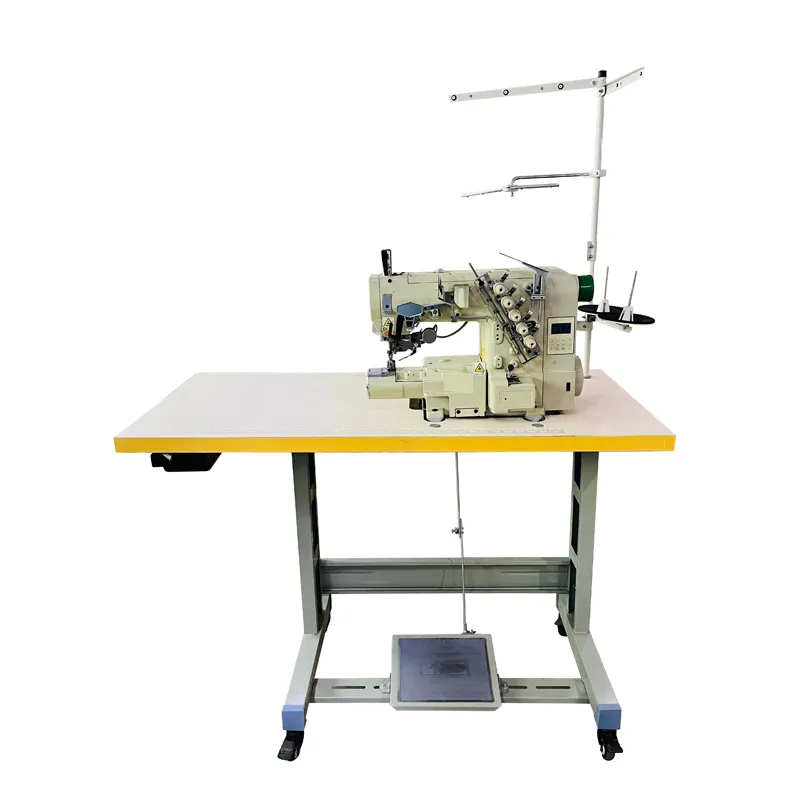
JINGNENG JN-1500 flat-bed six-thread four-needle sewing machine for footwear production.
A useful industry example is JUKI's flat-bed industrial sewing equipment for sports and leather shoes, which demonstrates that flat-bed construction still has important footwear applications when the workpiece geometry and stitch operation suit a broad horizontal bed.
Post Bed vs Cylinder Bed vs Flat Bed Sewing Machine Comparison
| Factor | Post Bed | Cylinder Bed | Flat Bed |
| Working Surface | Narrow vertical post | Narrow horizontal cylinder | Broad horizontal table |
| Workpiece Movement | Rotates around raised sewing point | Slides or wraps around horizontal arm | Moves across flat surface |
| Curved Shoe Uppers | Very practical for many upper-sewing operations | Useful when component can fit around arm | More restricted once component becomes highly three-dimensional |
| Tubular Components | Suitable for certain shaped areas | Strong advantage | Limited access |
| Large Flat Panels | Possible but not always most convenient | Depends on arm and table support | Strong advantage |
| Operator Visibility Around Curves | Generally very good due to narrow post | Good around cylindrical work | Good for open flat work |
Which Bed Type Is Better for Shoe Upper Sewing?
For shoe upper sewing, the most important question is not simply whether the material is leather or textile. Ask how three-dimensional the component has become at the moment the seam is sewn.
Flat upper components before assembly A flat-bed configuration may provide convenient support when panels remain open and can move freely across a broad table.
Curved or partially assembled shoe uppers A post bed becomes useful when the material needs to rotate around tight curves or when the table of a flat-bed machine interferes with the shaped upper.
Tubular, binding or wrap-around operations Cylinder-bed geometry is particularly useful when the component can slide over the arm and rotate around it during sewing.
Choose the Machine by Seam Location, Not Only by Product Name
Saying that a factory produces “shoes” is not enough information to select a sewing machine. One shoe may require several completely different sewing operations.
| Sewing Situation | Geometry to Consider |
| Decorative stitching on a flat upper panel | Flat-bed or specialized pattern-sewing equipment may be practical. |
| Stitching around a curved sneaker upper | Post-bed geometry can improve access and workpiece rotation. |
| Binding the edge of a thick leather component | A suitable cylinder-bed binding configuration may be appropriate. |
| Sewing a specialized four-needle seam | Stitch structure and machine configuration may matter more than bed shape alone. |
Bed Type Is Only One Part of the Sewing Machine Specification
Two machines with the same bed geometry can perform very differently. After deciding which shape gives the operator enough access, compare the feeding system and sewing specifications.
| Specification | Why It Matters |
| Feed Mechanism | Determines how reliably multiple or slippery layers move through the sewing point. |
| Presser-Foot Lift | Must provide enough clearance for the actual material stack. |
| Stitch Length | Should match seam appearance, material strength and production requirements. |
| Needle Configuration | Single, double or multi-needle configurations serve different structural and decorative seams. |
| Automation | Automatic trimming, back stitching, positioning and presser-foot lifting can reduce repeated manual actions. |
JINGNENG Machine Examples: Different Beds for Different Jobs
The following machines illustrate why bed geometry should be considered together with the actual sewing configuration. They are not direct substitutes for one another because their needle systems, feed mechanisms and intended sewing processes differ.
| Example | Bed Type | Main Characteristic | Example Specification |
| JN-2592BTF | Post Bed | Double-needle shoe and leather sewing with programmable functions | 2500 spm / 12 mm presser-foot lift |
| JN-205V | Cylinder Bed | Binding and sewing thicker shoes, bags and leather products | 20 mm presser-foot lift / 0–11 mm stitch length |
| JN-1500 | Flat Bed | Specialized six-thread four-needle footwear sewing | 3500 spm / 17 mm presser-foot lift |
7 Questions to Answer Before Buying an Industrial Shoe Sewing Machine
1. Is the component flat, tubular or already three-dimensional?
2. Where is the seam located on the finished product?
3. How much material must pass around or beneath the sewing point?
4. What is the maximum material-stack thickness?
5. Do you need one, two or multiple needles?
6. Does the material require roller feed, upper-and-lower feed or another feeding system?
7. Which automatic functions reduce repeated operator actions in your production line?
Sewing Machine Selection Should Match the Entire Shoe Upper Process
Sewing performance is also affected by the work completed before the component reaches the sewing station. Cutting determines panel dimensions, skiving controls edge thickness, gluing and folding can change the material stack, and moulding may later create additional three-dimensional form.
For a broader view of how these operations connect, see How Does the Shoe Upper Manufacturing Process Work? or browse the complete JINGNENG shoe sewing machine range.
Post Bed vs Cylinder Bed vs Flat Bed FAQs
Is a post bed sewing machine better for shoes?
Post-bed machines are particularly useful for many curved and three-dimensional shoe-upper sewing operations because the narrow raised post improves access around shaped components. However, flat-bed, cylinder-bed and other specialized machines can still be more appropriate for other footwear seams.
Can a cylinder bed sewing machine be used for shoes?
Yes. Cylinder-bed machines can be used for selected shoe, binding and thick-material operations where the component can pass around the cylindrical arm. Machine configuration and seam geometry should be checked before selection.
What is a flat bed sewing machine best used for?
Flat-bed machines are convenient for components that remain flat or open during sewing. They provide a broad support surface for panels and straight sewing operations and are available in many specialized industrial configurations.
Can a post bed replace a cylinder bed machine?
Not in every operation. Although both provide better access than a conventional flat bed for certain shaped products, their geometry is different. A cylinder bed is designed for work that wraps around a horizontal arm, while a post bed provides open space around a raised vertical sewing point.
Does bed type determine how thick the machine can sew?
No. Material capacity also depends on the feed mechanism, presser-foot lift, needle system, motor, hook, thread and the specific machine design. Bed geometry mainly determines how the workpiece can be positioned around the sewing point.
What information should I send before choosing a shoe sewing machine?
Provide the shoe or leather product type, photos of the component and seam position, material and thickness, number of layers, stitch requirements, needle quantity and target production capacity. A sample or sewing video can make machine selection more accurate.
The Best Bed Type Is the One That Gives the Seam Enough Access
The practical difference between post bed, cylinder bed and flat bed sewing machines is primarily how they support and position the product around the needle. Flat beds support open panels, cylinder beds allow work to wrap around a horizontal arm, and post beds provide clearance around a raised sewing point for curved and three-dimensional components.
After selecting the appropriate geometry, compare feed mechanism, needle configuration, presser-foot lift, stitch length and automation functions. This prevents a factory from choosing a machine that has impressive specifications but cannot comfortably reach the actual seam.
Not Sure Which Shoe Sewing Machine Fits Your Seam?
Send JINGNENG a photo or sample of the shoe component, mark the required sewing path, and provide the material thickness, number of layers and stitch requirements. This makes it easier to determine whether a post bed, cylinder bed, flat bed or another specialized shoe sewing machine is the better match for the operation.
 English